

On this page
Picture this: you're organizing a group dinner with colleagues from different backgrounds. One person follows a halal diet, another keeps kosher, a third practices Jainism, and a fourth is vegan. The table goes quiet. Where on earth do you even begin looking at the menu?
This scenario plays out in restaurants across London, Dubai, Singapore, and Sydney every single day. And while these four dietary systems come from very different places, religiously, ethically, and philosophically, they share more common ground than most people realize. Understanding the halal kosher Jain vegan overlap doesn't just ease the stress of group dining. It opens up a smarter, more inclusive way of thinking about food entirely.
Let's map it out properly.
The Four Systems: A Quick Grounding
Before we get into what overlaps, it helps to understand what each system is actually doing and why.
Halal
Halal is an Arabic word meaning "permissible." In dietary terms, it refers to foods that comply with Islamic law as defined in the Quran. The most well-known rules involve the prohibition of pork and pork by-products, alcohol, and blood. Meat must be slaughtered in a specific way, with the animal's blood fully drained and a blessing spoken at the time of slaughter. Shellfish is a grey area, with some schools of Islamic thought permitting it and others not.
Kosher
Kosher dietary laws (kashrut) come from Jewish religious texts, particularly the Torah and Talmud. Like halal, kosher prohibits pork and requires specific slaughter methods. But kosher has some unique requirements: meat and dairy cannot be eaten together, shellfish and other non-finned sea creatures are forbidden, and food must be certified by a recognized religious authority. Interestingly, the meat-dairy separation often makes kosher meals more restrictive than halal in practical restaurant settings.
Jain
Jain dietary practice is rooted in the principle of ahimsa, meaning non-violence or non-harm. Jains are strict vegetarians, but the restrictions go further than most vegetarian diets. Root vegetables like onions, garlic, potatoes, and carrots are avoided because harvesting them kills the entire plant (and the microorganisms living in the soil). Many Jains also avoid eating after sunset, and some stricter practitioners follow a raw or limited-cooked-food approach.
Vegan
Veganism is an ethical lifestyle choice that excludes all animal products: meat, fish, dairy, eggs, honey, and any ingredient derived from animals. Unlike the three religious systems above, veganism has no central religious text or governing body. Its rules are shaped by ethics, environmental concern, and health considerations, which means individual vegans may interpret it slightly differently.
Where the Four Systems Actually Intersect
Now for the Venn diagram. When you layer these four systems on top of each other, some clear zones of overlap emerge. Understanding religious dietary restrictions side by side reveals that the intersection is broader than most diners expect.
Category | Halal | Kosher | Jain | Vegan |
|---|---|---|---|---|
Pork | Prohibited | Prohibited | Prohibited (all meat) | Prohibited |
Alcohol | Prohibited | Permitted (if kosher) | Generally avoided | Generally permitted |
Beef | Permitted (if halal-slaughtered) | Permitted (if kosher-slaughtered) | Prohibited | Prohibited |
Dairy | Permitted | Permitted (not with meat) | Permitted | Prohibited |
Eggs | Permitted | Permitted | Often avoided | Prohibited |
Shellfish | Debated | Prohibited | Prohibited (all animal) | Prohibited |
Root vegetables (garlic, onion) | Permitted | Permitted | Prohibited | Permitted |
Fruits and vegetables | Permitted | Permitted (checked for insects) | Permitted (above-ground) | Permitted |
Legumes and grains | Permitted | Permitted | Permitted | Permitted |
The Sweet Spot: What All Four Share
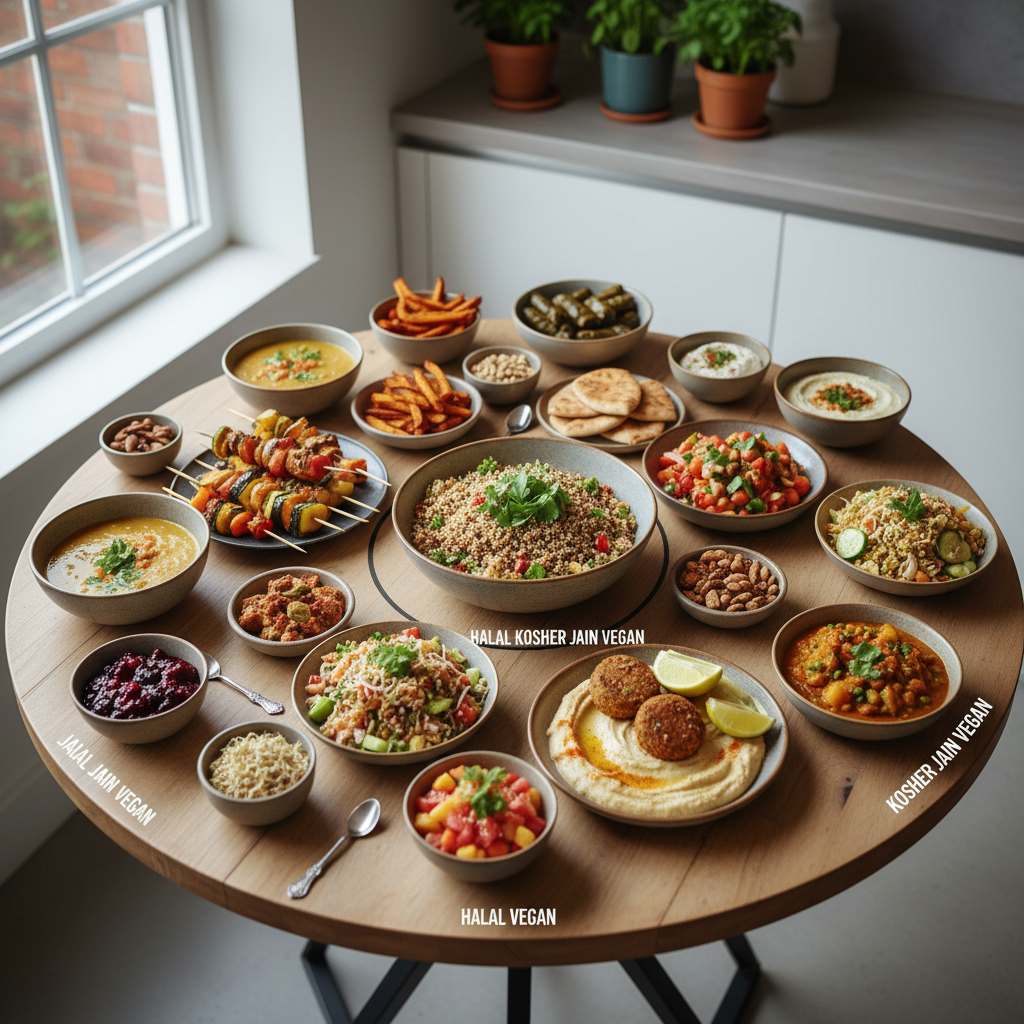
The clearest overlap between halal, kosher, Jain, and vegan is a shared safe zone of whole plant foods. Above-ground vegetables, fruits, legumes, nuts, seeds, and grains tend to be acceptable across all four frameworks (with careful sourcing and preparation). This is the practical goldmine for anyone planning a multi-faith dining menu or cooking for a mixed group.
Dishes like a dal with tomato and coconut milk, a grain salad with roasted peppers and chickpeas, or a simple fruit platter can genuinely satisfy all four systems at once, assuming no cross-contamination and no hidden animal-derived food additives in sauces or dressings.
The Fault Lines: Where Things Get Complicated
Acknowledging the overlap is the first step. Knowing where things diverge is equally important, because assuming one label covers another is where dining experiences go wrong.
Halal vs. Kosher: Close but Not Interchangeable
The halal kosher differences catch many people off guard, because the two systems look similar on the surface. Both prohibit pork. Both require specific slaughter methods. But here's where they split:
- Kosher prohibits mixing meat and dairy (separate dishes, utensils, and often waiting periods between). Halal has no such rule.
- Kosher prohibits shellfish entirely. Halal permits most fish and seafood, depending on school of thought.
- Kosher meat and halal meat are slaughtered differently. Most halal authorities do not accept kosher slaughter as equivalent, and vice versa.
- Wine and alcohol used in kosher cooking (for example, kosher wine in a sauce) would make that dish non-halal.
So no: a kosher restaurant is not automatically halal-safe, and a halal restaurant is not automatically kosher-compliant. This matters enormously when recommending menu accommodations for multiple religions at the same table.
Vegan vs. Jain: Closer Than Most Think, But Not the Same
Veganism and Jain eating share a core commitment to avoiding animal products. But Jain practice introduces restrictions that go well beyond veganism. A dish of garlic-roasted eggplant is perfectly vegan. For a Jain practitioner, it's not acceptable because of the garlic. Many Indian restaurants in cities like Mumbai or London have started labeling Jain-friendly options specifically, which is a welcome development for clarity.
Eggs add another wrinkle. Many vegans avoid eggs, but some dietary vegans (as opposed to lifestyle vegans) consume them. Jains traditionally avoid eggs entirely. When dining in a group, these distinctions matter more than people expect.
A Balanced View: The Limits of Finding Perfect Overlap
It's worth being honest here. While the faith-based diet overlap is real and useful, there are genuine limits to how neatly these systems align in a restaurant setting.
Certification is one of the biggest complications. A dish that looks kosher, halal, and vegan on paper might fail on preparation grounds. Was the pan also used for pork? Was the oil refined from animal products? Were the vegetables checked for insects (a kosher requirement)? Restaurant kitchens are busy, often chaotic environments, and most servers, however well-meaning, don't always have the detailed knowledge to answer these questions accurately.
Research from Food Allergy Research and Education consistently shows that cross-contact is one of the leading causes of unintended dietary exposure in restaurant settings. The same principle applies to religious and ethical dietary requirements: it's not just about the ingredients, but the entire handling chain.
There's also the matter of individual interpretation. Not every Muslim, Jewish, Jain, or vegan practitioner follows exactly the same rules. Some are more observant than others. Some have made personal decisions about grey areas. This is not a flaw in any of these systems. It's simply the reality of how people live their values in a diverse world. Assuming that one label tells you everything is the mistake to avoid.
How to Navigate Group Dining Across These Four Systems
The good news is that with a little preparation and the right tools, dining as a mixed group across these four dietary traditions is genuinely achievable. At Align Eat, we built our platform specifically for moments like this: when a menu feels like a puzzle and you need clear, reliable answers fast.
Practical Strategies for Mixed-Group Restaurant Dining
- Choose restaurants with plant-forward menus. Cuisines like Indian, Middle Eastern, and Mediterranean naturally feature dishes that can satisfy halal, kosher, Jain, and vegan requirements simultaneously, especially when ordered without meat.
- Communicate the full picture upfront. Rather than saying "we have a vegan," tell the kitchen the specific restrictions. "No meat, no dairy, no eggs, no onion or garlic" is more actionable than a label alone.
- Scan the menu in advance. Using an AI-powered menu tool to decode a restaurant's offerings before you arrive removes the time pressure and lets everyone plan their order with confidence.
- Focus on the shared zone. Build the table around dishes that work for everyone, rather than trying to find individual options for each person that happen to coexist on the table.
Looking Ahead: The Future of Inclusive Menus
The restaurant industry is beginning to catch up with the complexity of modern diners' needs. We're already seeing menus in cities like Dubai, London, and Melbourne that label dishes with multiple dietary icons: halal-certified, vegan, gluten-free, and Jain-friendly all on the same line. Some restaurants are partnering with religious certification bodies and dietary consultants to create menus that are genuinely inclusive from the ground up rather than as an afterthought.
AI is going to accelerate this significantly. As technology gets better at parsing ingredients, cooking methods, and certification details in real time, the gap between what a menu says and what a diner actually needs to know will shrink. Imagine scanning a menu anywhere in the world and instantly seeing which dishes fall into that sweet spot of halal-kosher-Jain-vegan overlap. That's not science fiction. That's where we're headed, and it's what we're working toward at Align Eat every day.
For diners managing complex dietary needs, this shift can't come soon enough. The combination of clearer restaurant labeling and smarter digital tools means that group dinners across faith and dietary lines will become less of a logistical puzzle and more of what they're supposed to be: a shared, enjoyable experience around good food.
Frequently Asked Questions
Is vegan food automatically halal and kosher?
Not always. Vegan food avoids all animal products, which aligns with many halal and kosher restrictions, but there are gaps. Kosher law requires that foods be certified by a recognized authority and that vegetables be checked for insects. Halal requirements include the absence of alcohol, which can appear in vegan products like certain vinegars, flavor extracts, or kombucha. Cross-contamination during preparation is also a concern in non-certified kitchens. So while vegan food is a strong starting point for overlap, it's not a guaranteed fit for strictly observant halal or kosher diners without further verification.
Can a Jain person eat at a halal or kosher restaurant?
Possibly, but with care. Both halal and kosher restaurants may serve dishes that are free of meat, but many will include ingredients that Jain practice avoids, particularly onion, garlic, and other root vegetables. These are common in Indian, Middle Eastern, and Jewish cuisine. A Jain diner would need to ask specifically about those ingredients and potentially request modifications. Some restaurants, particularly those with Indian ownership, may already understand Jain requirements and be willing to accommodate them. Communication is key, and having a clear list of what to avoid helps enormously.
What dishes are genuinely safe for a mixed halal, kosher, Jain, and vegan group?
The safest options tend to be dishes built entirely from above-ground vegetables, fruits, legumes, grains, and nuts, prepared without animal-derived ingredients, alcohol-based additives, or root vegetables like onion and garlic. Think a simple lentil and tomato soup seasoned with cumin and coriander, a grain salad with roasted bell peppers and herbs, or a fruit and nut platter. The challenge is preparation: these dishes need to be cooked in clean pans without shared utensils from meat or dairy preparations. In practice, calling ahead to a restaurant and explaining the group's needs together produces far better results than navigating the menu alone at the table.